
FIMP Is Finally Fully in Place: A Half-Century Goal Achieved, But More Work Ahead
Dear FIA Members and Friends:
I have waited a long time to be able to write this letter. As you may have seen in Newsday, the U.S. Army Corps of Engineers (USACE) and the New York State Department of Environmental Conservation (NYSDEC) finally signed the FIMP Project Partnership Agreement (PPA) last week. This cost-sharing agreement between the federal government and New York State was the last essential piece of the FIMP (Fire Island to Montauk Point) framework—the one everything else was waiting on. Together with the six local agreements already in place between the DEC, Suffolk County, and the five South Shore Towns (Babylon, Islip, Brookhaven, Southampton, East Hampton), the FIMP shoreline management program is now fully executed and standing on firm contractual ground.
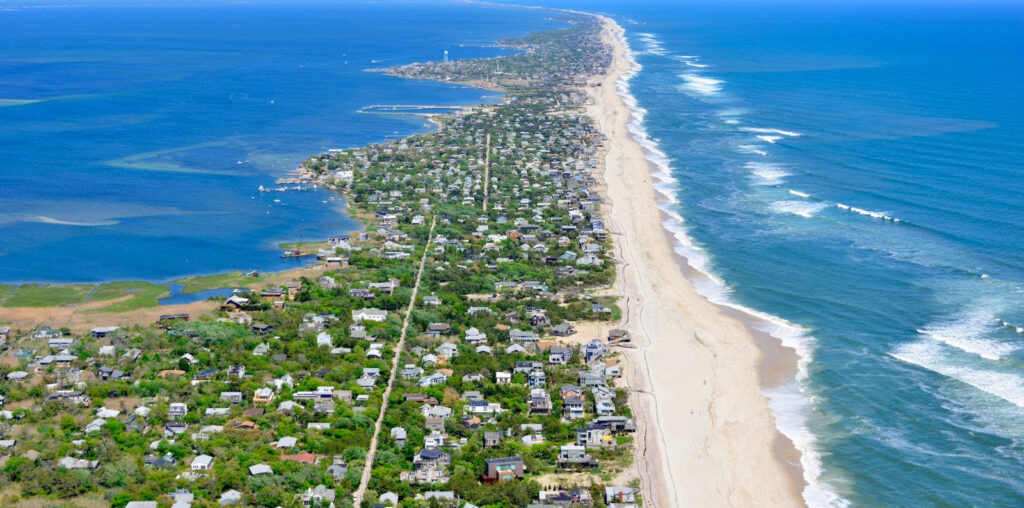
Here is what that means for Fire Island: our beaches are now part of a 30-year program of routine, proactive renourishment, with sand placed back on our beaches roughly every four years—or sooner, when serious erosion occurs up and down the island. No more scrambling to rebuild after every devastating storm.
Long-time FIA members know just how hard-won this achievement is. For newer members, a brief look back shows why this moment matters so much.
How We Got Here: A Goal Three Generations
in the Making
The story begins with the Hurricane of 1938, which tore through Long Island and made one thing unmistakably clear: the South Shore needed a comprehensive plan for coastal protection. In 1960, Congress authorized the Army Corps to develop the Fire Island Inlet to Montauk Point plan (FIMP): a blueprint for managing 83 miles of ocean shoreline as one interconnected system of beaches, dunes, and inlets. (In that same era, Robert Moses tried to use beach protection as the rationale for building a highway down Fire Island. But Islanders famously defeated the Moses Road.)
The FIMP proposal languished for decades, widely written off as too big and too complex to ever succeed. Through all those years, FIA worked relentlessly to keep the plan alive, lobbying the Corps and Congress for continued funding to study FIMP. When the 1991 Halloween storm pounded the island, our communities couldn’t wait for FIMP. We took protection into our own hands, forming Erosion Control Districts and organizing beach rebuilding projects through FEMA. But by the mid-2000s, we faced a genuine crisis. FIMP was still stalled, and the Fire Island National Seashore refused to approve permits for further FEMA beach projects. Fire Island was in a tough bind, with no reliable way to renourish our beaches.
Superstorm Sandy changed everything. The devastation of 2012 brought federal recovery funding that paid for emergency repair of Fire Island’s beaches and dunes through the FIMI (Fire Island to Moriches Inlet) project—at 100% federal expense. Most importantly, Senator Schumer and the NY Congressional delegation led the successful fight to resurrect, authorize, and win final approval for the FIMP plan.
The Final Piece, and the People Who Delivered It
The last remaining step in getting the FIMP renourishment cycle in place was the PPA between the Army Corps and the New York State DEC. This agreement documents the cost-sharing formula agreed upon by the federal, state, and local partners, and allows construction dollars to flow. The Corps cannot spend a single federal construction dollar without it. No PPA, no project. With last week’s signing, the funding structure for FIMP’s 30-year renourishment program is now secured: the federal government pays 50 percent of any future renourishment, the State contributes 35 percent, and the local share comes to 15 percent.
Before the Corps and DEC would sign their own agreement, the six local PPAs between the DEC, Suffolk County, and the five South Shore Towns all had to be in place. This complex paper chase took two and a half years of persistent effort. Many thanks to Henry Robin and FIPPOA and Tom Ruskin and the Seaview Association, who worked tirelessly with me and Steve Williams of Cherry Grove, FIA consultants Eric Hofmeister and George Hoffman, and East End Coastal consultant Aram Terchunian. Our PPA team, masterfully advised and supported by Andrew Kirtzman of KSX Communications and John Tomlin of Taconic Strategies, also partnered seamlessly with the Governor’s office and DEC leadership, pressing our sense of urgency to lock in these federal/state/local agreements in the face of stronger storms, rising seas, and volatile federal policies affecting Army Corps shoreline projects.
The Critical Next Step: Securing the Federal Dollars
This 30-year commitment to beach projects for Fire Island does not run on autopilot. Governor Hochul, an enthusiastic champion of Fire Island, urged the Legislature to commit to the State’s 35% cost share with an extraordinary $1.7 billion in future funding authorized in the 2025 State budget. The Fire Island communities will pay the 15% local share through our Erosion Control Districts in the Towns of Islip and Brookhaven. The federal 50% share, however, depends on Congress. In Washington’s budget-slashing atmosphere, securing renourishment funds will require sustained advocacy by our Fire Island communities. Our shoreline management team will be working closely with our Congressional delegation, especially Senator Schumer, a longtime and passionate champion of Fire Island’s beaches, to get funding for Fire Island beach renourishment into the federal budget. This effort is every bit as important as getting all those PPAs signed. It is how we will turn cost-sharing agreements on paper into sand on our beaches.
Please join me in celebrating the decades of advocacy—by FIA, by our member communities, and by successive waves of federal, state, and local partners—that finally carried the FIMP shoreline management program across the finish line last week. This is an amazing achievement, one that will help assure the integrity and sustainability of Fire Island’s dunes, berms, and beaches far into the future.
Thank you very much for your continued support as we launch this new era of beach stewardship, enabled by FIMP and powered by our determined advocacy on behalf of the island we all love!
With appreciation,

Suzy Goldhirsch
President, Fire Island Association